
THE SCIENCE
OF STAYING
FAST.
The objective is not simply to make a tire last longer. The objective is to better understand the mechanisms that cause performance to degrade — and to develop tools that help preserve performance throughout the operating cycle.
"Quantum Sloth Racing exists to explore how advanced science, engineering, and data-driven decision making can transform the way performance is understood and sustained in complex systems."
PERFORMANCE
DOESN'T JUST
DISAPPEAR.
IT DEGRADES.
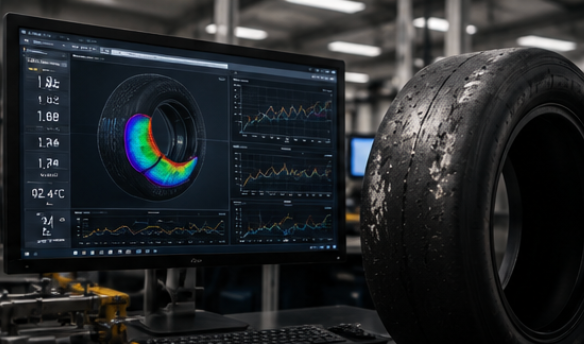
Tire degradation is one of the most complex, multi-variable phenomena in motorsport. Thermal cycling, mechanical stress, chemical breakdown, and surface interaction all contribute — simultaneously, non-linearly, and in ways that interact with each other.
Most approaches treat degradation as a constraint to manage. QSR treats it as a system to understand — building models that predict, explain, and ultimately help preserve performance across the full operating cycle.
SEVEN ACTIVE
RESEARCH THREADS.
TIRE DEGRADATION BEHAVIOR
Characterizing the mechanisms — thermal, mechanical, chemical — that cause grip and consistency to fall off. Building models that predict degradation onset, rate, and cliff behavior under varying track and environmental conditions.
PERFORMANCE CONSISTENCY
Understanding why lap times vary even when conditions appear stable. Identifying the subtle compound interactions, driver inputs, and environmental factors that create performance variance — and developing tools to minimize it.
ENVIRONMENTAL IMPACT MODELING
Quantifying how ambient temperature, humidity, track surface evolution, and weather transitions affect tire behavior. Building real-time environmental correction models that adjust performance predictions dynamically.
PREDICTIVE ANALYTICS
Moving from reactive analysis to proactive prediction. Hybrid physics-ML models that forecast performance windows, degradation cliffs, and optimal operating conditions before they occur — giving engineers and strategists a time advantage.
TELEMETRY-DRIVEN DECISION SUPPORT
Closing the loop between high-frequency sensor data and real-time engineering decisions. Developing interfaces and algorithms that surface the right insight at the right moment — under the time pressure of live competition.
ADVANCED SIMULATION ENVIRONMENTS
Full-fidelity digital twin environments that replicate tire-track-vehicle interaction at the physics level. Enabling rapid hypothesis testing, scenario exploration, and model validation without consuming track time.
NOVEL MATHEMATICAL APPROACHES TO DYNAMIC SYSTEM OPTIMIZATION
Exploring emerging mathematical frameworks — quantum-inspired optimization, probabilistic graphical models, topological data analysis, and novel numerical methods — for their applicability to the high-dimensional, rapidly-evolving optimization problems that define competitive motorsport. The track is the proving ground. The mathematics is the mechanic.
HOW WE
WORK.
We don't treat the tire as a black box. Every model is grounded in the physical mechanisms at work — contact mechanics, thermodynamics, viscoelastic material behavior — with machine learning used to capture the residuals that physics alone can't explain.
Pure data-driven models fail when conditions shift outside the training distribution. Pure physics models miss the complexity of real-world interaction. QSR's hybrid approach combines the generalizability of physics with the adaptability of machine learning.
Sensor data at 100Hz+ across dozens of channels per vehicle. Custom ingestion pipelines handle synchronization, noise filtering, and feature extraction in near-real-time — feeding both live decision support and post-session model refinement.
Every model prediction is tested against real-world data. Gaps between prediction and reality are not failures — they are the primary driver of research progress. The track is the ultimate validator, and we treat every session as a controlled experiment.
Analysis that doesn't reach the decision-maker in time is worthless. Every tool and interface is designed around the specific decision it supports — with latency, clarity, and cognitive load as first-class engineering constraints.
Performance research operates within strict safety and reliability boundaries. No optimization is pursued that compromises structural integrity, driver safety, or system reliability. Measurable engineering outcomes, not theoretical maximums.

TIRES THAT DISAPPEAR.
PERFORMANCE THAT STAYS.
THE MECHANIC
WORKS ON
MORE THAN
TIRES.
The tools, models, and methodologies developed through motorsport research have direct applicability to any domain where complex systems must perform reliably under rapidly changing real-world conditions — with high stakes and limited time to respond.
Autonomous Systems
Predictive degradation models and real-time decision frameworks apply directly to autonomous vehicle reliability and edge-case handling.
Advanced Sensing Networks
High-frequency telemetry architectures and sensor fusion techniques developed on-track translate to distributed sensing infrastructure.
Cybersecurity & Communications
High-bandwidth, low-latency data links under adversarial conditions mirror the requirements of secure communications infrastructure.
Decision Support Systems
Interfaces and algorithms designed for pit-wall decision-making under time pressure generalize to any high-stakes operational environment.
WORK ON
HARD PROBLEMS.
QSR collaborates with engineers, data scientists, physicists, and researchers who want to apply rigorous methods to real-world performance challenges. The track is open.